
Transform Your Workspace with Sit-Stand Desks for Better Health and Productivity
For generations, office workers have sat. Sat through eight-hour workdays, sat through meetings, sat while their bodies deteriorated from prolonged sedentary behavior. But the modern workplace is shifting. Forward-thinking companies are recognizing that the simple act of standing transforms not only employee health but also their engagement, productivity, and long-term job satisfaction. Height-adjustable desks, especially when integrated into cubicle systems, have become the game-changing solution that gives employees the freedom to work the way their bodies demand.
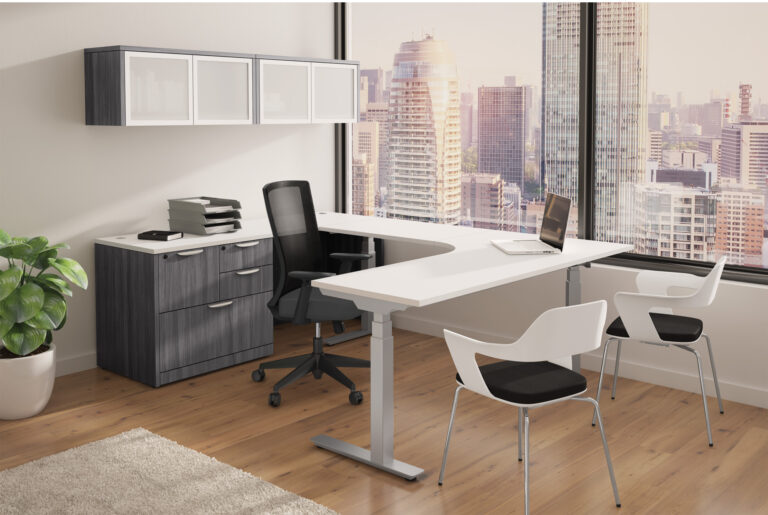
At Front Desk Office Furniture, we understand that a cubicle isn’t just a space, it’s a tool for employee wellbeing. Our height-adjustable desks are engineered to seamlessly integrate with your existing cubicle infrastructure, giving teams the flexibility to alternate between sitting and standing throughout the day. The research is compelling: employees using sit-stand desks report 17% less sitting time, 47% reduction in upper back and neck discomfort, and 65% increased productivity after one year. But beyond statistics, there’s something profoundly simple about giving employees agency over their work environment. When your team can adjust their workspace to match their energy levels and physical needs, they become more engaged, more creative, and more committed to your organization. Let’s explore how height-adjustable desks can revolutionize your cubicle design strategy.
Understanding the Problem: Why Sitting All Day Matters
The Hidden Cost of Sedentary Work
Office workers typically sit for 73% of their workday and 66% of their waking hours. This isn’t just uncomfortable; it’s dangerous. Research shows that excessive sitting is linked to a 10-20% increased risk of premature death and chronic disease. Sitting longer than eight hours daily heightens the risk of cardiovascular disease, metabolic disorders, and musculoskeletal pain. One study found that excessive sitting may be responsible for over 430,000 deaths globally.
When employees spend entire days seated in traditional cubicles, they experience afternoon fatigue, neck and shoulder tension, and declining mental clarity. Traditional desk setups inadvertently create an environment that works against human health.
How Height-Adjustable Desks Change This
Height-adjustable desks fundamentally alter this dynamic. By allowing employees to shift between sitting and standing throughout the day, these desks reduce sedentary time without requiring employees to leave their workspace. The Steelcase-sponsored Mount Sinai study found that after just three months, users of height-adjustable desks sat 50 fewer minutes daily, increasing to 82 fewer minutes per day after one year.
The Research-Backed Benefits
Physical Health and Comfort
The evidence for height-adjustable desks is robust. In the Steelcase study, 47% of users reported significant reduction in upper back, shoulder, and neck discomfort after 12 months. Additionally, 65% of employees reported experiencing improved overall health outside the workplace. Texas A&M research found that office workers using standing or sit-stand desks experienced lower back discomfort at less than half the rate of traditional desk users (just over 50% versus 80%).
These aren’t temporary improvements; they’re sustained benefits from changing how we work.
Productivity and Engagement Gains
One of the biggest misconceptions about standing desks is that they reduce productivity. The opposite is true. A Texas A&M study found that productivity increased 23% over the first month of use and jumped to 53% over six months. Steelcase research showed 65% of height-adjustable desk users reported increased productivity and better concentration ability. One study of call center employees found that standing desk users were 45% more productive than seated workers.
Beyond raw productivity metrics, employees report feeling more awake, refreshed, energetic, and limber. This translates to better problem-solving, quicker task completion, and improved collaboration.
Mental Health and Mood
Research from 2025 indicates that standing desks reduce anxiety and stress while improving mood. Because prolonged sitting is associated with increased depression and anxiety symptoms, the opportunity to move and change posture provides psychological relief. The mental health benefits are particularly important for remote workers and those who spend their entire day in open cubicle environments.
Integrating Height-Adjustable Desks into Cubicle Design
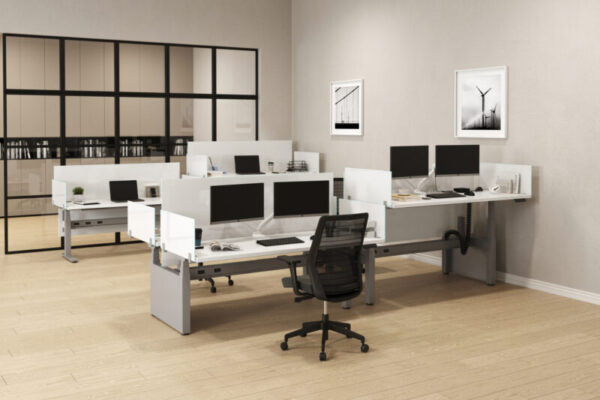
Modern cubicle systems are designed to accommodate height-adjustable desks seamlessly. Unlike traditional fixed desks, today’s sit-stand solutions integrate with modular cubicle walls, integrated power management, and cable routing systems. The key is selecting systems that allow for smooth transitions between sitting and standing without disrupting your colleagues’ workflows.
Consider implementing height-adjustable desks in phases, starting with high-traffic departments where the productivity gains are most visible. Pair your hardware investment with brief training—studies show that reminders and education help employees use adjustable desks more consistently.
The Bottom Line: Invest in Your Team
Height-adjustable desks represent a straightforward investment in employee wellbeing and productivity. The data is clear: your team will be healthier, more engaged, and significantly more productive. More importantly, offering these options signals that your company values employee health, which improves retention and attracts talent in a competitive market.
Ready to transform your workspace? Contact Front Desk Office Furniture today. Let our ergonomic specialists help you design a cubicle system with height-adjustable desks perfectly suited to your team’s needs. We’ll assess your current space, recommend the right solutions, and provide professional installation and training. Call us for a free workspace consultation and discover how simple changes create remarkable improvements in how your team works.